
- Telephone:0086-579-88916293Setting home page|Collect the station
BONA Power
0086-579-88916293
Fax:0086-579-83109683
E-mail:info@bonatools.com
Address:lanxi,jinhuacity,zhejiangprovince china
I'd like to talk insulation to pick the brains of those in the know.
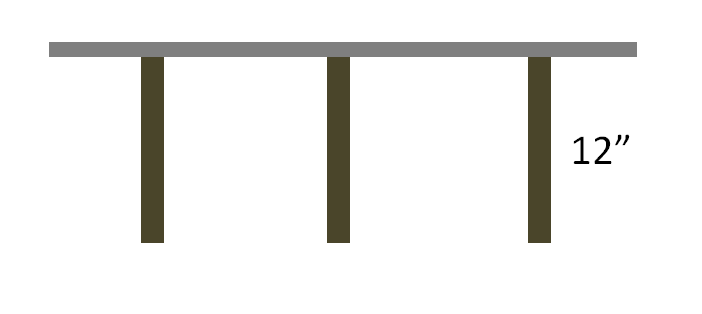
The attic in my house currently has no insulation at all, a legacy of the failed renovation contractor engagement. The house has a cathedral ceiling so the "attic" is really just the underside of the roof and is fully open to the rest of the house. There is no enclosed and sealed attic really. The red part is the what has no insulation currently. Actually, there's no insulation on the floor area of the attic either, but that's not really an especially exciting discussion.

The rafters are 12" deep and 16" on center - nothing oddball there thankfully.
I'm going to install new insulation myself, but I think I need a bit more information on the right and wrong way to do it.
The first option would be to install faced R-38 insulation. I'm pretty sure that I'd also need to install baffles to ensure the proper gap. That's Option 1.

While that would work, I've been told that I really ought to investigate reflective insulation. That's where things get complicated. From my research, I'd use something like this.
The installation instructions on this say that it needs a 1" air gap to be effective and that it can be used as a vapor barrier with unfaced insulation. The first problem, and it's my problem, is that Lowes has a 30% off insulation deal on now that doesn't include unfaced R-38, so I'd be using kraft paper faced and it would look like this.
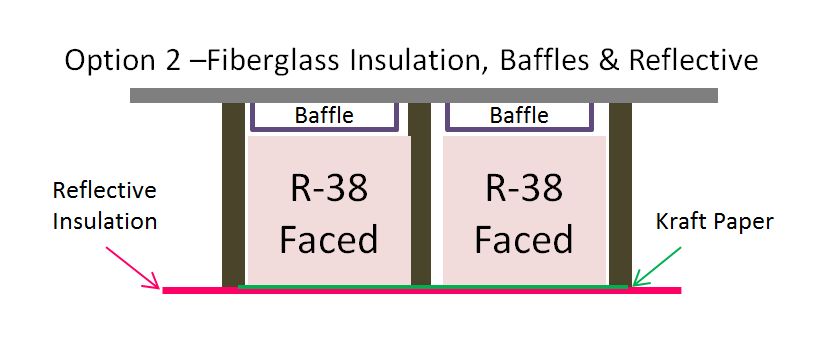
Well, that doesn't give the required gap between the paper and the reflective insulation. Does it matter?
In my research, I also see that in NC, you can install the bubble reflective insulation directly against the roof decking, again as long as you have the 1" air gap beneath it. That brings me to Option 2a.

I'd still have to put in baffles on top of the reflective insulation and I'd still be using faced insulation stapled to the rafters.
So, those are my choices. I'd like some input from anyone that knows more than I do on this topic - meaning probably just about everyone 
Here are my questions.
1. Should I bother with reflective insulation in addition to the fiberglass?
2. If I do use the reflective insulation, is it OK to use with faced insulation (Option 2)?
3. If I go with option 2a, do I still need a plastic sheet vapor barrier on top of the faced insulation (This is where the green line would be in diagram 2a)
As always, thank you all a ton for your experience and advice.
